
Step-by-Step Marble God Idol Manufacturing Process
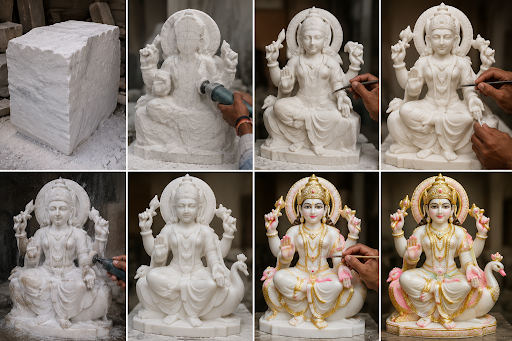
Marble murtis from Jaipur carry something that is hard to explain in words. The Marble God Idol Manufacturing Process draws devotees from across India and abroad, not just for the beauty of the stone but for the bhav that lives in every finished form.
A raw marble block gives nothing away. Yet in the hands of a craftsman who has spent years learning this work, that same block slowly becomes Lord Krishna, Ganesh Ji, Hanuman Ji, Radha Krishna, Durga Maa, Shiv Parivar, or whichever deity a devotee holds dear. In Jaipur, this is not stone work. Let me explain the journey in a simple way.
Selecting the Right Marble Stone
A good murti always begins with a good stone. Most trusted workshops source marble from the Makrana quarries of Rajasthan. Makrana marble has earned its place over generations. Temples, monuments, and devotional idols across India have been built from it because the stone holds well, finishes smoothly, and stays clean white for years.
The Makrana marble murti making process begins before any tool touches the block. Artisans check every surface closely. A crack that looks small, a dark patch, an uneven grain line, any of these can become a serious problem mid-carving or during transport. The stone has to be right from the start.
Temple idols demand even more from the marble. Fingers, crowns, ornaments, eyes, lotus bases, these details only come out well when the stone cooperates. As for colour, some customers want that sharp pure white, while others lean toward a softer cream. Both are available, and the choice usually comes down to the deity, the temple light, and personal feeling. The right choice depends on the deity, temple space, and final finish.
Planning the Design and Marking the Block
Before the first cut, the design is studied properly. The customer can share a photo, drawing, requirement for the height or a measurement of the temple. The artisan checks posture, face style, hand position, ornaments, base, and proportion.
This is where many people ask, how are marble god idols made in India with such balanced expressions? The answer is practice, tradition, and careful planning. The artisan follows known forms, but every murti still needs personal judgement.
Once the design is final, the marble block is marked. Lines show the head, shoulders, hands, base, front, and side views. This guides rough shaping and helps prevent waste. A wrong cut can spoil the full block, so senior craftsmen usually guide this work.
Rough Shaping with Chisel and Tools
After marking, the extra stone is removed. This is called rough shaping. The statue does not look finished yet. Only the basic body, posture, and base begin to appear. The artisan works slowly because marble has its own nature. If the idol has a tall crown, wide arms, or a detailed seat, enough stone must be left for later hand work.
This is an important stage in the Marble idol carving process in Jaipur. In the artisan lanes of Bhindo Ka Rasta in Chandpol Bazar, skilled hands work on murtis every day. The sound of tools, white marble dust, and the quiet focus of craftsmen are part of Jaipur’s old murti tradition.
Hand Carving the Face, Hands, and Details
Once the rough shape is ready, fine hand carving begins. This is the stage where the murti starts to feel alive. The face, eyes, nose, lips, hands, feet, clothes, crown, ornaments, and sacred symbols are shaped with smaller tools.
The face needs the most care. A peaceful smile, soft eyes, and graceful expression make a big difference. Devotees connect with the face first, so this work cannot be rushed. This is why Handmade marble idols are still valued so much. Machines can cut basic shapes, but they cannot give the warmth of an artisan’s hand. A craftsman adjusts each curve by looking at the stone and deity form.
In Marble statue making in Jaipur, detailing may take many days or even weeks. A simple idol takes less time. A heavily ornamented temple murti with jewellery and carved base takes much longer.
Smoothing, Polishing, and Final Decoration
After carving, the surface still has tool marks. The smoothing team uses different grades of abrasives to make the marble soft and clean. The work starts with stronger sanding and moves to finer finishing. Polishing gives the murti its final glow. Some customers like a bright, glossy finish. Others prefer a gentle natural shine. For temple idols, the finish should look graceful under diya light and natural light.
Some murtis remain pure white. Others receive light painting on the eyes, lips, tilak, clothes, or ornaments. Netra work, gold detailing, and small colour touches are done carefully. Before packing, the statue is checked from all sides. The base should be stable. The polish should be uniform. The slender ones should be safe. All of this is properly examined on the basis of the face, the hands, the ornaments and the back.
Simple Estimated Timeline for Marble Murti Making
Timelines change with size, detail, stone quality, quantity, and delivery location.
Packing and Safe Delivery
A finished murti deserves the same care in packing as it got on the carving table. A finished marble murti must be protected before it leaves the workshop. The statue is cleaned, wrapped with soft foam, covered with stretch film, and protected around delicate parts like crowns, hands, fingers, and ornaments.
For large temple orders, strong wooden crates are used. Many workshops pack heavy idols at Shahpura along the Jaipur-Delhi Highway because the area is suitable for loading and long-distance transport. Internal support is added so the idol does not move inside the crate.
Small idols may travel by courier or air cargo. Large murtis usually move by truck or container. Statues are packed properly to reach homes, temples, ashrams and overseas destinations safely.
Final Perspective
The Marble God Idol Manufacturing Process moves through many hands before a murti is ready for worship. Stone selection, design planning, rough shaping, hand carving, polishing, decoration, packing, and delivery. Each stage feeds into the next. A murti should look beautiful, but it should also feel peaceful and balanced where it is installed.
For custom temple idols, home mandir statues, or large marble orders, Sharma Marble Moorti Bhandar welcomes questions about size, design, marble quality, finishing style, packing, and transport. A good murti begins with the right stone, the right hands, and a clear conversation with the devotee.