
Different Sizes and Designs of Khodiyar Mata Marble Murtis
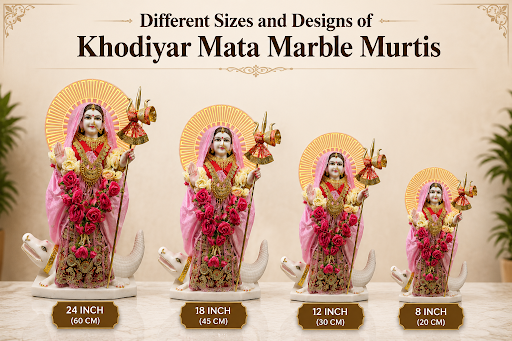
Welcome, and Jai Khodiyar Maa. When devotees ask us about Khodiyar Mata marble statue designs, they are usually not only asking about size or price. They are asking how Maa’s presence can be brought into their home mandir, family temple, village shrine, or large trust temple with the right expression, posture, and respect.
Khodiyar Mata is worshipped with deep love by families in Gujarat, Rajasthan, and many places across the world. Her murti is special because her form carries strength, protection, and motherly grace. Her crocodile vehicle, her divine weapons, her crown, and her calm face all need careful attention. A good idol should not look like a plain statue. It should feel like a form made with shraddha.
Choosing the Purest Stone for Maa
Every Khodiyar Maa murti begins with the right marble block. We usually select stone from the Makrana quarries of Rajasthan because Makrana marble has a bright, pure look and a strong body. The white marble Khodiyar Mata murti is a great choice for a temple at home or even in a larger mandir.
Before we carve, we look at the block from all sides. We look for cracks, dark marks, weak lines and uneven areas. The stone should be strong enough to bear the crown, the hands, the ornaments, the weapons and the base of the crocodile. If the marble has hidden weakness, it can create trouble later. Many people think the process starts with carving. In truth, it starts with choosing the right stone.
Understanding the Size and Temple Space
The size of the murti plays a vital role in justifying its beauty. Not every murti needs to be large, as a home mandir may need a small and peaceful idol. Alternatively, a community temple may need a stronger and taller form. A trust temple, on the other hand, may want a completely carved scene with Khodiyar Maa seated or standing with her crocodile vehicle.
This is why devotees often ask about different sizes of Khodiyar Mata marble murtis before placing an order. Size should match the place of worship and viewing distance. A small murti needs softer detailing. A large murti needs stronger facial features, deeper carving, and a base that looks balanced from far away.
For homes, many families choose compact sizes that can be cleaned and decorated easily. Temples are like big idols with detailed ornaments and weapons on a wide platform, so trustees prefer it that way.
Drawing the Form Before the First Cut
Once the size is decided, we prepare the design. Some devotees bring an old family reference. Some want a traditional Gujarati style. Some prefer a Jaipur hand-carved finish with a brighter crown and detailed ornaments.
The main points are checked first. Maa’s face should be calm but powerful, and her posture should look graceful. The crocodile should not look like a rough animal shape. It should support the full divine form. The crown, jewellery, clothes, weapons, and base must all work together.
As a custom Khodiyar Mata marble murti manufacturer, the work is never copied blindly. Every order has a purpose. Some idols are made for daily puja, some for pran pratishtha and others for family devotion across generations.
Rough Shaping in the Jaipur Workshop
After marking the marble, rough shaping begins. This is when extra stone is removed and the basic form comes out. At this stage, the murti still looks unfinished. You may only see the rough outline of Maa, her seat, the crocodile, and the base.
In the artisan lanes of Bhindo Ka Rasta in Chandpol Bazar, Jaipur, this work has its own sound. Chisels strike stone, marble dust gathers on the floor, and the craftsmen check the shape again and again from the front, side, and back. The rough shaping must leave enough marble for fine details. If too much stone is removed early, the crown, fingers, ornaments, or crocodile teeth may become weak. A good artisan always thinks two steps ahead.
Fine Detailing of the Crocodile, Crown, and Weapons
This is the stage where Khodiyar Maa’s identity becomes clear. The face is shaped slowly. The eyes, nose, lips, chin, and cheeks are carved with care. Her expression should not look harsh. It should show strength with kindness.
Then the decorations begin with the crown, necklace, earrings, bangles, waist belt and clothing folds, which are all handmade. The weapons are formed using the selected design. In many traditional forms, devotees ask for a sword, trishul, or other divine symbols. Some prefer one hand in blessing or want a more detailed temple-style form.
The crocodile vehicle needs special attention. Its body, mouth, feet, back, and tail must look strong enough to carry Maa’s form. If the crocodile is too plain, the idol feels incomplete. If it is too heavy, it can take attention away from the Goddess.
The best Khodiyar Mata marble murti designs are not always the most crowded designs. They are the ones where face, posture, weapons, ornaments, and base all sit together in harmony.
Hand Polishing with Water and Stones
After carving, the surface has small tool marks. Polishing removes these marks and brings softness to the marble. We use water and polishing stones in stages. When the rough surface slowly becomes smooth, the shine comes little by little.
A bright polish looks beautiful, but it should not hide the carving. The face, fingers, ornaments, and crocodile details must remain clear. Some customers like a pure white finish. Others ask for light colour work on the eyes, lips, tilak, crown, or ornaments.
When the polishing is complete, we clean the murti and inspect it in natural light. This is important. Marble can look different under workshop light and temple light.
Basic Timeline for Khodiyar Mata Marble Murtis
The timeline can change with design detail, marble selection, painting work, polish style, and packing needs.
Safe Wooden Crating for Delivery
A marble murti is heavy, delicate, and sacred, and packing must be done with care. First, the idol is cleaned and wrapped with soft padding. Then foam, film, and corner protection are added around delicate parts like the crown, hands, weapons, and crocodile details.
For bigger orders, our large-scale crating work is handled at bigger workshops in Shahpura along the Jaipur-Delhi Highway. Strong wooden crates are made to hold the murti firmly. Internal support is added so the idol does not move during transport.
Small murtis may go by courier or air cargo. Large temple idols usually move by truck or container. Good packing protects both the stone and the devotion behind it.
Final Perspective
Choosing the right Khodiyar Maa murti is not only about height. Think about the place where she will sit, the distance from which devotees will take darshan, the level of ornament work, the crocodile base, and the style of polish. A home mandir needs a peaceful size. A temple needs strong proportions and clear detailing.
At Sharma Marble Moorti Bhandar, we welcome devotees, families, and temple trustees to sit down with us and discuss their custom vision. Whether you want a simple white idol or detailed Khodiyar Mata marble statue designs for a larger mandir, the right murti begins with a clear conversation, the right Makrana stone, and hands that respect the sacred work.